

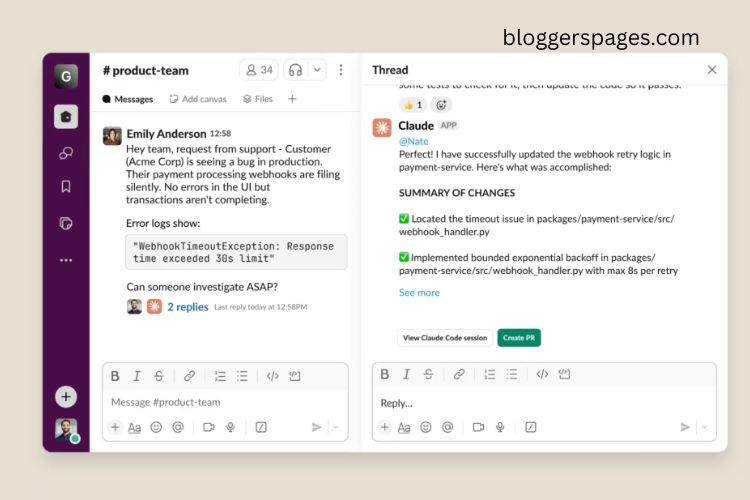
Anthropic is taking a bold step in AI-powered software development with the launch of Claude Code in Slack, a feature designed to let developers delegate coding tasks directly from chat threads. This beta functionality, rolling out Monday as a research preview, builds on Anthropic’s existing Slack integration by introducing full workflow automation, signaling a major shift in how coding assistants are used. The industry is moving beyond simple code suggestions—the next frontier lies in streamlined, collaborative workflows.
Previously, Claude in Slack provided developers with lightweight coding assistance: writing snippets, debugging, and offering explanations. While helpful, these interactions were limited in scope and required switching between applications or tools. Claude Code changes that paradigm. Developers can now tag @Claude to launch a complete coding session, drawing context from Slack messages such as bug reports, feature requests, or discussion threads. Claude automatically analyzes recent messages, identifies the correct repository, posts progress updates in the conversation, and shares links for code review or pull requests. This creates a seamless transition from conversation to code, reducing friction in daily developer tasks.
Read More: I Tested Google’s Prototype Smart Glasses — They Nearly Made Me Ditch My Phone Forever!
AI Coding Assistants Move Beyond IDEs
The introduction of Claude Code reflects a broader trend in the software industry: AI coding assistants are moving from integrated development environments (IDEs) into collaboration platforms where teams already spend their time. This transition highlights the importance of context-aware tools that can understand team communication, not just code.
Other players are following a similar path. Cursor offers Slack integration to draft and debug code directly in threads, while GitHub Copilot recently added functionality to generate pull requests from chat. OpenAI’s Codex is also available through custom Slack bots, making collaboration-focused AI a growing trend. By embedding AI into collaboration tools, companies can reduce context switching, streamline workflows, and accelerate project delivery.
Slack as the New AI Hub
For Slack, positioning itself as an “agentic hub”—where AI tools integrate deeply with workplace communication—provides a strategic edge. The platform already serves as the center of engineering communication in countless organizations, and whichever AI tool dominates Slack could reshape the way software teams operate. Claude Code leverages this by letting developers execute complex coding tasks without leaving the chat environment.
This shift is significant because it changes how teams approach development. Instead of toggling between IDEs, issue trackers, and chat applications, developers can move seamlessly from discussion to coding. Updates, pull requests, and progress reports can all occur in one place, reducing delays and improving team efficiency. For project managers and team leads, this means greater visibility into development processes and faster turnaround on critical tasks.
Enhancing Workflow Automation with Claude Code
Claude Code is not just a coding assistant; it represents full workflow automation. By analyzing Slack threads and understanding context, the AI can determine which repositories to access, which branches to work on, and which tasks require immediate attention. It can then update the team in real time, providing a transparent and trackable workflow that integrates naturally into the team’s communication rhythm.
This level of automation is poised to accelerate project timelines, allowing developers to focus on creative problem-solving rather than repetitive tasks. It also introduces a new standard for AI integration: tools are no longer evaluated solely on their coding capabilities but also on how well they fit into existing collaboration workflows.
Security and IP Considerations
While Claude Code offers numerous benefits, it also introduces new security considerations. Giving an AI access to repositories through Slack raises questions about code security and intellectual property protection. Teams must carefully manage permissions and audit access, ensuring that sensitive information is not inadvertently exposed. Additionally, dependencies on Slack and Claude’s APIs create potential vulnerabilities: outages or rate limits could disrupt development workflows that were previously fully under local control.
Organizations adopting Claude Code will need to implement robust security protocols and backup workflows to mitigate potential risks. The balance between convenience and security will be crucial in determining adoption rates across different industries.
Market Competition and Strategic Timing
Anthropic’s rollout comes at a critical moment in the AI coding market, which is becoming increasingly competitive. As companies like OpenAI, GitHub, and Cursor enhance their collaboration-focused AI offerings, differentiation is shifting from purely model capabilities to integration depth and accessibility. The ability to embed AI seamlessly into daily workflows, especially on platforms like Slack, is emerging as a key competitive advantage.
By launching Claude Code as a research preview, Anthropic gains early feedback from developers, allowing them to refine functionality, address security concerns, and optimize workflow integration before a broader rollout. This strategy positions them well in a market where timing and execution are as critical as technology.
Future Implications for Developer Collaboration
The arrival of Claude Code signals a fundamental shift in software development. AI-embedded collaboration is poised to redefine developer workflows, making teams more agile and projects more transparent. Key implications include:
- Reduced context switching: Developers no longer need to move between Slack, IDEs, and code repositories, improving focus and efficiency.
- Improved project visibility: Real-time updates in Slack threads make it easier for team leads to track progress and identify bottlenecks.
- Accelerated iteration: Immediate coding assistance and workflow automation allow teams to implement features faster and respond to bugs more quickly.
- Enhanced collaboration: Teams can work together on coding tasks directly within communication platforms, promoting shared understanding and collective problem-solving.
If widely adopted, AI integrations like Claude Code could reshape standard development practices, making collaboration tools central to coding, testing, and deployment processes.
The Broader AI Collaboration Landscape
Claude Code’s launch is part of a larger trend where AI is moving beyond individual productivity and becoming a key driver of team efficiency. As more companies embed AI into communication tools, the distinction between coding and collaboration blurs. AI assistants will not only write code but also facilitate decision-making, prioritize tasks, and coordinate workflows, essentially acting as virtual team members.
This shift has implications for both enterprise software strategy and startup innovation. Organizations that adopt these tools early can gain a competitive edge, while developers can focus on high-value tasks, leaving routine coding and workflow management to AI.
Frequently Asked Questions:
What is Claude Code?
Claude Code is an AI-powered coding assistant from Anthropic that integrates with Slack, allowing developers to execute coding tasks directly from chat threads. It helps with coding, debugging, generating pull requests, and automating workflows.
How does Claude Code work in Slack?
Developers can tag @Claude in a Slack thread, and it uses context from messages, bug reports, or feature requests to determine the right repository and coding actions. Claude then posts progress updates, shares review links, and manages pull requests, all within Slack.
What makes Claude Code different from other AI coding tools?
Unlike traditional AI assistants that work mainly in IDEs, Claude Code focuses on workflow automation and collaboration inside Slack. It reduces context switching and integrates coding tasks directly into team communication.
Is Claude Code available for everyone?
Currently, Claude Code is in a beta research preview. Developers can access it on Slack to test features and provide feedback, with broader availability expected in future updates.
Which other platforms offer similar AI coding integrations?
Other AI coding tools with Slack integration include Cursor for drafting and debugging code and GitHub Copilot, which can generate pull requests from chat. OpenAI’s Codex is also accessible through custom Slack bots.
Does Claude Code raise security concerns?
Yes. Since Claude accesses code repositories through Slack, teams must manage permissions carefully and audit access. Dependencies on Slack and Claude’s APIs also introduce potential workflow risks in case of outages.
How does Claude Code improve developer workflows?
Claude Code streamlines the transition from conversation to coding, automates routine tasks, posts updates in real time, and enables better collaboration. This increases efficiency, reduces errors, and accelerates project timelines.
Conclusion
Claude Code’s arrival in Slack marks a pivotal moment in AI-assisted software development. By combining coding intelligence with workflow automation, it allows developers to move seamlessly from conversation to code, reducing context switching and accelerating project delivery. While security and integration challenges remain, the potential benefits—enhanced collaboration, real-time updates, and improved efficiency—make it a game-changing tool for development teams. As AI coding assistants continue to evolve, platforms like Slack will become central hubs where innovation, communication, and productivity converge, reshaping the way software teams work.
